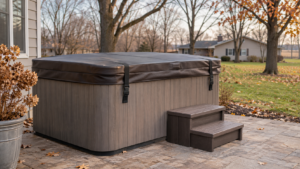
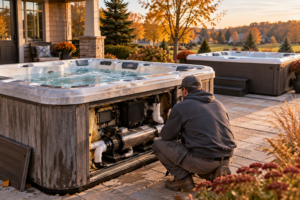
Hot tub repair often starts with a frustrating discovery: the water is cold, the jets have stopped working, or an unfamiliar error code is flashing on the control panel. Before assuming that an expensive component has failed, it helps to understand what these symptoms actually mean.
Many hot tub problems have relatively simple causes. A clogged filter can prevent the heater from operating, a low water level can interrupt circulation, and an incorrectly positioned diverter valve can make perfectly functional jets seem broken. Other problems, particularly those involving electricity, internal plumbing, or damaged pumps, require professional diagnosis.
For homeowners in Des Moines, Pella, and surrounding central Iowa communities, recognizing the difference is especially valuable during winter. This guide covers 12 common spa problems, the possible causes behind them, safe troubleshooting steps, and when to call a professional technician.
Hot Tub Repair Troubleshooting: Start With These Basic Checks
Before investigating individual components, check a few fundamental operating conditions.
Modern hot tubs contain safety sensors designed to protect the equipment when water flow, temperature, or electrical conditions fall outside acceptable limits. A shutdown may be a response to another problem rather than a failure of the component that stopped operating.
Check the water level
Low water can allow air into the circulation system and prevent pumps from moving water properly.
Confirm that the water reaches the level specified in your owner's manual. Do not run pumps if the water level is below the manufacturer's minimum requirement.
Inspect the filter
A dirty filter restricts water flow, sometimes enough to trigger a heater or circulation error.
Remove and clean the filter only according to the manufacturer's instructions, with the system safely switched off as directed. Never use a household detergent unless the filter manufacturer specifically approves it.
Review the control panel
Check the selected temperature, operating mode, and any displayed error messages.
Write down the exact error code. Similar-looking codes can mean different things depending on the spa's manufacturer and control system.
Listen for unusual noises
Pump sounds provide useful troubleshooting clues.
A motor that hums but does not move water may have a starting or mechanical problem. Grinding can indicate bearing wear, while a rattling or gravel-like sound may suggest cavitation.
Look for signs of water loss
Inspect the ground around the spa and any visible, safely accessible plumbing areas.
Persistent puddles, unusually rapid water loss, or moisture near electrical equipment should be investigated.
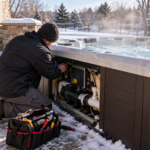
If the issue is beyond routine homeowner maintenance, Odyssey Spas provides professional hot tub repair services for most major brands throughout Des Moines, Pella, and surrounding central Iowa communities.
Quick Reference: 12 Common Hot Tub Problems
| Problem | Possible cause | Safe homeowner check | When professional service is needed |
|---|---|---|---|
| Not heating | Flow restriction, sensor, or heater failure | Water level, filter, heat setting | Heating remains inactive |
| GFCI tripping | Ground fault, moisture, damaged component | Observe when it trips | Every repeated trip |
| Jets not working | Closed valve, airlock, pump failure | Jet controls, water level | Pump will not circulate |
| Weak jet pressure | Clogged filter or circulation restriction | Filter, diverter settings | Low pressure continues |
| Water leaks | Seals, unions, cracked plumbing | Observe external water loss | Persistent leakage |
| Error codes | Flow, sensor, or temperature fault | Record code, consult manual | Code returns |
| Cloudy water | Chemical imbalance, poor filtration | Test water, clean filter | Persistent water problems |
| Noisy pump | Bearings, cavitation, impeller damage | Check water level | Grinding or overheating |
| Flow errors | Dirty filter or circulation failure | Filter, water level | Error remains |
| Control panel failure | Topside panel or control board issue | Check display and settings | Controls stay unresponsive |
| Water too hot | Sensor or control problem | Stop use, verify temperature | Overheating repeats |
| Hot tub won't turn on | Power or control fault | External breaker status | Spa remains without power |
1. Hot Tub Not Heating Properly
A hot tub that runs but fails to heat is one of the most common equipment complaints.
It is tempting to assume that the heating element has burned out, but several conditions can prevent an otherwise functional heater from operating.
Common symptoms
The water temperature remains below the selected setting, heating seems unusually slow, or the spa displays a heater-related error.
In some cases, the jets work normally even though the water stays cold.
What might be causing it?
Possible causes include:
- Dirty or clogged filter cartridge.
- Low water level or insufficient circulation.
- Malfunctioning temperature sensor.
- Failed heating element.
- Faulty heater relay or control system.
- Incorrect heating mode or temperature setting.
Heating systems often depend on adequate circulation to operate safely. If water is not moving correctly, the spa may disable heating to prevent damage.
Safe troubleshooting steps
First, confirm that the selected temperature is higher than the current water temperature.
Check whether the spa is operating in a standard heating mode rather than an economy or sleep mode. Then inspect the water level and clean the filter if necessary.
If a flow-related error appears, follow the manufacturer's approved instructions.
When to call a professional
If heating does not resume after these checks, a technician may need to test the heater, sensors, circulation system, and related controls.
Avoid replacing the heating element based on symptoms alone.
2. Hot Tub GFCI Keeps Tripping
A GFCI breaker protects against dangerous electrical ground faults. When it trips repeatedly, the problem should never be ignored.
Common symptoms
The breaker trips immediately after being switched on, the spa shuts down when a pump starts, or power cuts out during a heating cycle.
What might be causing it?
Potential causes include damaged heater components, moisture inside electrical equipment, motor insulation failure, faulty wiring, or a defective GFCI breaker.
The timing of the trip may provide a diagnostic clue, but it does not identify the faulty component with certainty.
Safe troubleshooting steps
Record when the breaker trips and whether any specific spa function seems associated with the shutdown.
Do not repeatedly reset it, disconnect grounding conductors, or open electrical enclosures.
Leave the affected circuit off until the cause has been evaluated.
When to call a professional
Repeated GFCI trips require qualified professional evaluation.
Electrical systems around water demand appropriate protection. The Pool and Hot Tub Alliance explains why maintaining electrical protection and correcting hazards is essential around spas.
3. Hot Tub Jets Not Working
If your hot tub's jets suddenly stop producing water, the cause may be mechanical or related to normal spa controls.
Common symptoms
An entire group of jets stops operating, individual jets produce no water, or the jet pump runs without delivering normal pressure.
What might be causing it?
Common causes include closed adjustable jets, an incorrectly positioned diverter valve, trapped air after a refill, or a pump malfunction.
Some spas have multiple jet pumps, so one seating area may operate normally while another does not.
Safe troubleshooting steps
Confirm that the appropriate jet controls are activated.
Check adjustable jet faces and diverter settings according to the owner's manual. Verify that the water level is sufficient.
If the problem began immediately after refilling, the pump may contain trapped air. Only use manufacturer-approved procedures for addressing airlocks.
When to call a professional
If the pump hums without moving water, repeatedly shuts off, or produces abnormal noises, stop attempting to operate it.
A technician can determine whether the problem involves the pump motor, impeller, control system, or plumbing.
4. Hot Tub Jets Have Weak Water Pressure
Jets that produce noticeably less pressure than normal can indicate restricted circulation.
However, low pressure does not necessarily mean that the jet pump needs replacement.
Common symptoms
Water movement feels weaker across several seats, jet pressure changes unexpectedly, or some jets perform differently than others.
What might be causing it?
Possible causes include:
- Clogged filter cartridges.
- Partially closed diverter valves.
- Low water level.
- Blocked or damaged jet components.
- Air entering the system.
- Worn pump components.
Safe troubleshooting steps
Start by checking the filter and water level.
Adjust the normal jet controls and diverter valves to confirm that water is being directed to the expected seating area.
Avoid inserting tools into jet openings or obstructing suction fittings.
When to call a professional
Persistent low pressure across multiple jets may indicate an internal circulation restriction, damaged pump impeller, or another mechanical problem.
Professional testing can help determine whether the restriction is in the filtration system, pump, or plumbing.
5. Hot Tub Leaking Water
A leaking spa can lose water from several locations, including the equipment compartment, jet fittings, and plumbing connections.
The visible puddle is not always directly beneath the damaged component.
Common symptoms
Water levels drop unexpectedly, moisture collects around the cabinet, or mineral deposits appear near accessible plumbing connections.
Leaks may become more noticeable while the pumps are operating.
What might be causing it?
Common sources include deteriorated pump seals, loose unions, cracked fittings, damaged jet connections, or leaks in concealed plumbing.
During Iowa winters, freezing water can expand inside pipes and create cracks that become apparent after thawing.
Safe troubleshooting steps
Observe how quickly the water level falls and whether leakage appears related to pump operation.
Look for obvious external signs of water loss without removing electrical covers or reaching into energized equipment.
Do not attempt to tighten internal fittings while the spa is operating.
When to call a professional
Persistent water loss requires inspection, particularly when the leak appears inside an insulated cabinet.
A technician may need to trace plumbing connections, inspect pump seals, or access concealed lines.
6. Hot Tub Displaying Error Codes
Digital spa controls display error messages when the system detects abnormal operating conditions.
Understanding those messages is useful, but error codes should not be treated as a complete diagnosis.
Common symptoms
The panel shows messages such as FLO, FL, DR, HL, or OH, depending on the control system.
Heating may stop, the pump may shut down, or the spa may enter a protective operating mode.
What might be causing it?
Errors can involve inadequate water flow, temperature sensors, overheating, communication faults, or other equipment conditions.
A flow error may result from a clogged filter rather than a defective flow sensor.
Safe troubleshooting steps
Record the exact message and consult the manufacturer's documentation.
If the message indicates a circulation issue, check the water level and filter.
Do not bypass sensors or repeatedly clear warnings without identifying the cause.
When to call a professional
Persistent or recurring errors usually require more detailed testing.
Professional diagnosis helps distinguish a failed component from a safety system responding correctly to another malfunction.
7. Cloudy Hot Tub Water That Won't Clear
Cloudy water is commonly associated with water chemistry, but it can also indicate a filtration or circulation problem.
A spa that looks clean on the surface may still have water that is unsuitable for use.
Common symptoms
The water appears cloudy, develops foam, contains suspended particles, or becomes difficult to keep balanced.
What might be causing it?
Potential causes include inadequate sanitizer, incorrect pH, organic contaminants, dirty filters, or insufficient circulation.
Mineral-rich fill water can also contribute to scale deposits and changes in water clarity.
Safe troubleshooting steps
Test sanitizer levels, pH, and alkalinity with an appropriate testing kit.
Clean the filter and follow the chemical manufacturer's instructions for correcting water balance. Avoid using the hot tub while sanitizer or other essential water conditions are outside recommended limits.
For additional steps, see our complete guide to cleaning a hot tub.
When to call a professional
If proper cleaning, filtration, and chemical treatment do not resolve the problem, the circulation system may need evaluation.
Odyssey Spas also carries water-care products, including BioGuard and SpaGuard, for routine spa maintenance.
8. Hot Tub Pump Making Grinding or Humming Noises
A pump that becomes louder than usual may be showing signs of mechanical trouble.
Identifying when the sound occurs can help narrow down the cause.
Common symptoms
You may hear grinding, persistent humming, squealing, rattling, or a sound resembling gravel moving through the pump.
Some noises occur only at high jet speed.
What might be causing it?
Possible causes include worn motor bearings, a damaged impeller, trapped air, low water flow, or internal mechanical wear.
Cavitation can occur when a pump does not receive adequate water, creating unusual noise and potentially damaging internal components.
Safe troubleshooting steps
Check that the water level is adequate.
Record whether the sound happens during filtration, heating, or jet operation.
Avoid removing pump covers or placing hands near moving equipment.
When to call a professional
Grinding, overheating, a burning smell, or a motor that hums without turning requires professional attention.
A technician can determine whether an individual component can be serviced or whether the pump assembly needs replacement.
9. Hot Tub Flow Error or Circulation Failure
A flow error means the spa's control system has detected a condition associated with inadequate circulation.
Because water movement is essential for heating and filtration, some spas automatically disable heating when these conditions occur.
Common symptoms
Flow-related messages appear, water movement decreases, or the heater refuses to activate.
What might be causing it?
Common possibilities include a clogged filter, low water level, airlock, failed circulation pump, or faulty flow-detection component.
Safe troubleshooting steps
Check the water level and clean the filter.
Review the owner's manual for the meaning of the displayed error and any approved homeowner procedures.
If the problem followed a water change, trapped air may be interfering with circulation.
When to call a professional
Recurring flow errors should be evaluated before further operation.
Never bypass a flow switch or pressure sensor to force the heater to run. These devices help prevent unsafe heating conditions.
10. Hot Tub Control Panel Not Responding
A malfunctioning control panel can interfere with temperature adjustments, jet activation, lighting, and other spa functions.
However, replacing the visible keypad may not solve the underlying issue.
Common symptoms
The display is blank, buttons do not respond, settings change unexpectedly, or functions operate intermittently.
What might be causing it?
Possible causes include moisture intrusion, a damaged topside panel, communication failure, control board malfunction, or power supply problems.
Safe troubleshooting steps
Determine whether the entire hot tub has stopped working or only the panel is affected.
Check the visible display for warnings and review the manufacturer's troubleshooting instructions.
Avoid opening electrical control boxes or unplugging internal communication cables.
When to call a professional
If the controls remain unresponsive, a technician may need to inspect the communication system, panel, and main control board.
Replacement components must be compatible with the spa's electronics.
11. Hot Tub Water Getting Too Hot
Water that exceeds the selected temperature is a safety concern.
An overheating warning may indicate an actual temperature problem, a sensor malfunction, or an issue involving the control system.
Common symptoms
The water feels hotter than expected, the display indicates an excessively high temperature, or the spa shuts down with an overheating warning.
What might be causing it?
Potential causes include defective sensors, incorrect temperature readings, control board problems, or unwanted heat accumulation during operation.
Safe troubleshooting steps
Stop using the spa immediately.
Check the displayed temperature without entering the water. An independent thermometer may help identify whether the reading appears inaccurate.
Do not override automatic temperature protection.
When to call a professional
Recurring overheating conditions require professional inspection.
The problem must be corrected before normal use resumes, particularly when the heater or controls appear to operate incorrectly.
12. Hot Tub Won't Turn On
A completely unresponsive spa may have an electrical supply problem or an internal control failure.
The troubleshooting approach depends partly on whether the hot tub uses a permanent electrical connection or a manufacturer-approved plug-in supply.
Common symptoms
The control panel is blank, no pumps operate, and the hot tub does not respond to its normal controls.
What might be causing it?
Potential causes include a power outage, tripped breaker, damaged electrical connection, faulty control equipment, or internal component failure.
Safe troubleshooting steps
Check whether your home has normal electrical service.
Observe the external breaker status without opening any enclosure. Do not repeatedly reset a breaker that trips again.
Never use extension cords, improvised wiring, or temporary electrical connections to power a hot tub.
When to call a professional
If the spa remains unresponsive, or power cannot be restored safely, arrange qualified service.
Electrical testing around water requires appropriate equipment, training, and safety procedures.
When Is DIY Hot Tub Repair Safe?
Some spa maintenance tasks are suitable for homeowners, while others should remain strictly professional.
| Generally safe homeowner tasks | Professional repair tasks |
|---|---|
| Testing water chemistry | Heater element replacement |
| Cleaning accessible filters | Electrical fault diagnosis |
| Checking water level | Pump motor repair |
| Adjusting normal jet controls | Control board replacement |
| Recording error messages | Internal plumbing repairs |
| Inspecting the cover | Wiring and GFCI repairs |
| Cleaning accessible shell surfaces | Safety sensor diagnosis |
Never attempt a repair that requires bypassing a safety device, working around exposed electrical connections, or reaching inside operating machinery.
For ordinary water changes, follow our step-by-step hot tub draining instructions and the procedures in your owner's manual.
Why Iowa Winters Make Hot Tub Repair More Urgent
Cold weather changes the consequences of certain equipment failures.
When the temperature drops below freezing, water trapped inside pumps, pipes, manifolds, and fittings can expand and damage those components.
The water inside the main spa shell may remain relatively warm while smaller plumbing sections cool much faster.
What to do when a hot tub stops heating in winter
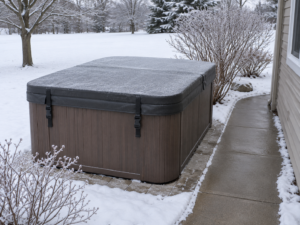
Keep the insulated cover securely closed if it is safe to do so.
Check whether the system still has normal circulation without opening any equipment enclosures.
If circulation or heating has failed, contact a service professional promptly.
Do not assume that draining the shell will remove all water from the plumbing. Proper winterization may require additional procedures to clear trapped water from internal components.
Avoid attempting to thaw frozen plumbing with open flames, heat guns, or improvised electrical heaters.
For homeowners concerned about cold-weather equipment failures, our guide to finding local hot tub repair in Des Moines explains what to look for when choosing a service company.
How Regular Maintenance Helps Prevent Costly Repairs
Not every mechanical failure is preventable, but routine maintenance helps reduce avoidable equipment stress.
Dirty filters restrict flow. Improper water chemistry can contribute to corrosion or scale formation. Low water levels can interfere with pump operation.
A practical maintenance routine should include checking water chemistry, monitoring circulation, keeping filters clean, and inspecting visible signs of water loss.
A simple homeowner maintenance schedule
| Frequency | Recommended task |
|---|---|
| Several times per week | Test sanitizer and pH |
| Weekly | Inspect water level and rinse filters as needed |
| Monthly | Inspect cover condition and check for unusual noises or leaks |
| Every 3–4 months | Arrange professional service |
| Seasonally | Review heating, circulation, and winter protection |
Actual maintenance frequency depends on spa use, manufacturer recommendations, and water conditions.
Odyssey Spas recommends professional service every three to four months.
For a more detailed maintenance plan, read our hot tub service and maintenance guide.
How to Make Your Hot Tub Repair Appointment More Effective
Getting the most out of a hot tub repair appointment starts before the technician arrives. Understanding your spa's symptoms, documenting when problems occur, and keeping track of recent maintenance can help identify the underlying issue. This is particularly useful when dealing with intermittent heating failures, circulation problems, or error codes that disappear before a technician can inspect them.
For homeowners scheduling hot tub repair in Des Moines or central Iowa, a little preparation can make the diagnostic process more straightforward and help prevent unnecessary component replacements.
Keep a Record of Recurring Problems
Some hot tub problems happen consistently, while others appear only under certain operating conditions. A heater might work during the day but struggle overnight, or a pump might produce unusual noises only when running at high speed.
Before your appointment, record the following:
- Temperature changes: Does the water gradually cool, or does heating stop suddenly?
- Pump behavior: Does the pump run continuously, intermittently, or not at all?
- Error messages: Which codes appear, and when do they disappear?
- Water loss: Does the water level drop faster when the jets are operating?
- Recent maintenance: Have you changed the filter, drained the spa, or adjusted the chemicals?
These observations give a hot tub repair technician useful information about how different components behave under normal operating conditions.
Understand Why Proper Diagnosis Matters
A hot tub contains several systems that depend on one another. For example, insufficient water circulation can prevent the heater from activating, even when the heating element is functioning properly.
During a hot tub repair visit, an experienced technician should consider how the pumps, sensors, plumbing, and controls work together before recommending replacement parts.
A noisy pump may need mechanical attention, but the sound could also result from trapped air or restricted water flow. Replacing the motor without identifying the actual cause might leave the original problem unresolved.
Consider the Condition of the Entire Spa
The age and overall condition of your hot tub can influence which repairs make financial sense. A relatively minor issue involving a sensor or plumbing fitting may be straightforward to correct, while multiple major component failures require a broader evaluation.
Because hot tub repair can involve several interconnected systems, it is worth asking whether other components show signs of wear or damage.
In Iowa, winter exposure deserves additional consideration. Previous freezing conditions may have damaged plumbing fittings or connections, even when only one leak is immediately visible.
Ask About Preventive Maintenance After the Repair
Before approving hot tub repair, ask the technician whether the problem could be related to maintenance conditions such as restricted filtration, improper water chemistry, or low water levels.
Some failures occur naturally as components wear out. Others may be made worse by preventable operating conditions.
Regular filter cleaning, proper water balance, adequate circulation, and seasonal inspections can help reduce unnecessary equipment stress.
Good hot tub repair is not simply about getting the equipment running again. It is also about understanding what caused the problem and identifying practical steps to support reliable operation in the future.
When to Call a Professional Hot Tub Repair Technician
Professional service is the safest choice when a problem involves electricity, internal equipment, major water leaks, or repeated operating failures.
Call a technician when:
- The GFCI breaker trips repeatedly.
- The heater fails despite normal water level and basic filter maintenance.
- Pumps grind, overheat, or stop circulating.
- Significant water loss occurs.
- Electrical controls stop functioning.
- Flow or temperature errors repeatedly return.
- The hot tub loses heat during freezing conditions.
A professional diagnosis should determine why a component stopped working rather than simply replacing the part associated with the most obvious symptom.
For example, poor circulation can prevent the heater from operating even when the heating element itself is functional.
If several major components have failed or the shell and plumbing show extensive damage, it may also be worth comparing repair costs with replacement. Our spa repair versus replacement guide explains how to evaluate that decision.
Frequently Asked Questions About Hot Tub Repair
1. What is the most common problem with hot tubs?
Heating and circulation problems are frequent reasons homeowners need service. Dirty filters, low water levels, faulty sensors, and pump malfunctions can cause similar symptoms. The actual cause varies by spa model and maintenance history, so basic water-flow checks are a useful starting point before replacing parts.
2. Can I fix my hot tub myself?
Homeowners can handle routine tasks such as cleaning filters, checking water levels, adjusting normal controls, and testing water chemistry. Repairs involving heaters, pumps, internal plumbing, electrical wiring, and control boards generally require professional expertise. Follow the manufacturer's instructions and never bypass electrical or temperature safety devices.
3. Why is my hot tub running but not heating?
The heater may be disabled because of inadequate water flow, a dirty filter, incorrect operating settings, or a malfunctioning sensor. A failed heating element is another possibility. Check the water level, filter, and selected heating mode first. Persistent problems should be professionally diagnosed.
4. How much does hot tub repair typically cost?
Costs depend on the failed component, required labor, and parts availability. Simple fitting or sensor repairs typically cost less than major pump replacements, electrical troubleshooting, or concealed plumbing repairs. There is no reliable single price for every situation. Contact Odyssey Spas for a quote based on your equipment.
5. Why does my hot tub GFCI keep tripping?
Repeated GFCI trips may indicate moisture intrusion, damaged wiring, a faulty heating element, or another electrical ground fault. A defective breaker is also possible. Leave the circuit off and arrange qualified inspection. Never bypass the GFCI or repeatedly reset it to keep the hot tub operating.
6. What should I do if my hot tub stops working during winter?
Keep the cover secured if conditions are safe and contact a service professional promptly. Heating and circulation failures increase freeze-damage risk during Iowa winters. Do not assume draining the shell protects internal plumbing, because water may remain trapped in pumps, fittings, and lines.
7. Does Odyssey Spas repair different hot tub brands?
Yes. Odyssey Spas provides repair and service for most major hot tub brands throughout Des Moines, Pella, and surrounding central Iowa communities. The company works on heaters, pumps, jets, leaks, plumbing, and control panels. Specific parts and repair options depend on the spa model and equipment condition.
Professional Hot Tub Repair in Des Moines and Central Iowa
Effective hot tub repair begins with finding the underlying cause of the problem.
A heater that stops working may actually have a circulation issue. Weak jets may result from a dirty filter rather than a failed pump. An error code may be a warning that a safety system is doing exactly what it should.
Knowing how to recognize these symptoms helps homeowners make better maintenance decisions and avoid unsafe repair attempts.
If your spa needs professional attention, Odyssey Spas provides hot tub repair for most major brands, give us a call!